This website uses cookies to give you the best possible experience on our website. We only use necessary and functional cookies.


10 teams are participating in the 2026 edition!
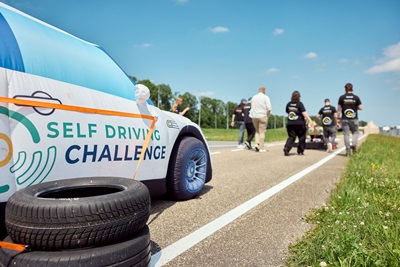
The Self Driving Challenge is a yearly event since 2019. Previous challenges included driving in a simulation environment and driving on a real race track. For edition 2025, a new custom track was designed to incorporate modern real world scenarios and regulations from UN ECE regulations R157 (Automated Lane Keeping Systems) and R171 (Advanced Driver Assistance Systems).
In 2026 we're bringing the heat back to the Lelystad track. Participants are participating in two categories: the closed and open category. In the open category, the teams are building their own autonomous vehicle. In the closed category, the RDW provides a kart. The track will be a little bit different than the previous years! The challenge starts officially on 12 Februari with the kick-off, and ends on June 16 with the grand final. In the months between, students are welcomed on the track in Lelystad to test their vehicles.
A brand new track has been created at the RDW Test Centre in Lelystad. This track will feature various real world challenges that autonomous vehicles may face and is is designed to incorporate modern real world scenarios and regulations from UN ECE regulations R157 (Automated Lane Keeping Systems) and R171 (Advanced Driver Assistance Systems). It is the task of the teams to program their vehicles to enable them to complete a course on the track - without any human intervention.
All in a timespan of February to June, after which teams will demonstrate their self-driving abilities on the final race day.
The track consists of a slightly smaller and simplified but realistic road design. The exact objectives will be given at the kick-off of the challenge in February. Various tasks and difficulties may include:

Teams will be able to participate in either a 'closed category' or an 'open category'. Teams in the open category will bring their own vehicle. Teams participating in the closed category will receive a computer from the RDW to program and control an electric RDW kart on loan. Discover all (vehicle) requirements here!
We recommend mixing MBO, HBO and WO-experiences and encourage participants from various backgrounds. Teams should ideally contain between 6 and 10 team members and must be supported by their educational institutions in terms of:
Non-technical guidance and project support.
Technical knowledge and other training materials.
Computing resources to develop and test systems.
Solutions for students’ weekly travel to Lelystad for testing.
In case of open category: ensure the development and availability of their vehicle on testing days in Lelystad.
Teams must have a member who is team captain and spokesperson. Students should commit at least 4 days a week to the challenge.
We recommend mixing MBO, HBO and WO-experiences and encourage participants from various backgrounds. Teams should ideally contain between 6 and 10 team members and must be supported by their educational institutions in terms of:
Non-technical guidance and project support.
Technical knowledge and other training materials.
Computing resources to develop and test systems.
Solutions for students’ weekly travel to Lelystad for testing.
In case of open category: ensure the development and availability of their vehicle on testing days in Lelystad.
Teams must have a member who is team captain and spokesperson. Students should commit at least 4 days a week to the challenge.
The challenge will be set-out on the RDW Test Centre in Lelystad (TCL). From February on, teams have the opportunity to analyse, record and test their project every week. On June 16th 2026, an exciting final event will be organized where all teams will demonstrate their abilities in front of a public audience and the winners of the Self Driving Challenge 2026 will be decided upon.
Teams will be able to participate in either a 'closed category' or an 'open category'. The RDW will provide the kick-off, webinars, technical information, testing-days and the final race event. The educational institutions are responsible for the necessary resources, supervision and guidance for their participating teams.